Kiteboarding Tips for Beginners: What I Wish I Knew When I Started

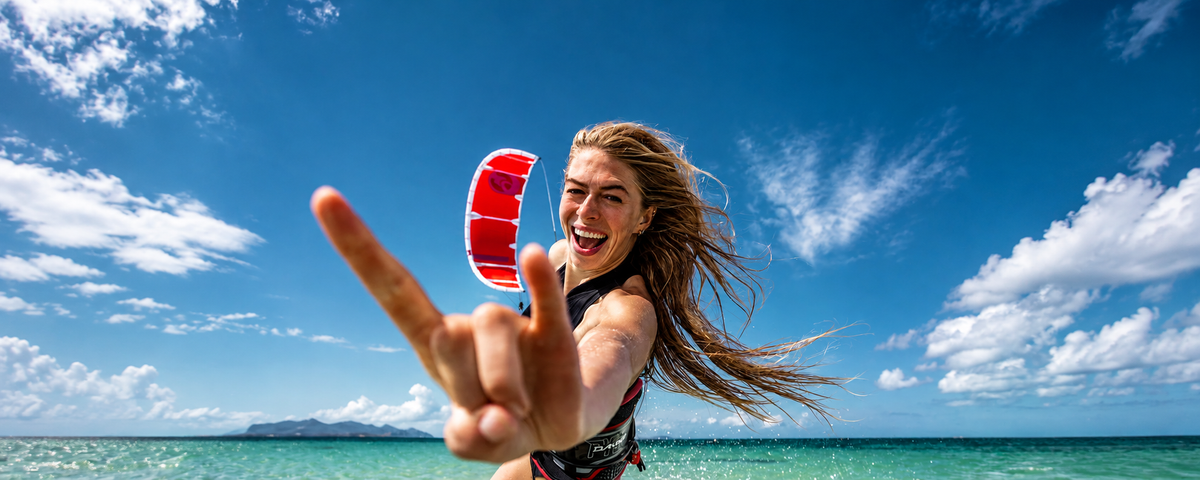
These are the kiteboarding tips for beginners that Cabrinha team rider Hannah Whiteley wishes someone had given her on day one.
Hannah has been kiteboarding since 2007, after learning from her dad, the first kitesurfer in the north-west of England. Today she rides freeride and big air for Cabrinha from her home spot in Lytham St Annes. Over to Hannah.
When you first start kiteboarding, you might expect to fall in love with it straight away. But the truth is, your passion for kitesurfing may take a little time to grow.
Learning to kitesurf is a challenge. In the beginning, you have to put in the time and effort, and there will usually be some crashes, frustration and days when it feels harder than it should.
But then something changes.
You reach the point where YOU are the one in control of the kite. You get up on the board. You start to ride.
And it really is one of the most incredible feelings in the world.
People often say, “Do something you’re passionate about,” but what I wish I’d known is that passion doesn’t always happen instantly. Sometimes, it grows as you learn, improve and overcome the difficult parts.
It’s often the things we don’t do in life that we regret. So give it time, stick with it and enjoy learning something completely new.
1. Don’t Rush to Get Up on the Board
One of the biggest pieces of advice I can give is don’t rush to get on the board.
Spend time becoming really confident flying the kite first. Kite control is everything.
If you’re just starting out, learn this with a qualified instructor at a certified kite school. They’ll teach you how to fly the kite safely and how your safety systems work before you ever head into the water.
Try to get to the point where you can almost feel where the kite is in the sky without constantly looking at it. Start by taking little glances away from the kite while you’re flying it and gradually build your confidence.
Later, when it’s time to add the board, having that instinctive kite control will make the whole process so much easier.

2. Be Kind to Yourself
Mother Nature is a constantly changing factor in kiteboarding.
You might have an amazing day where you’re getting up on the board and everything seems to click. Then you come back the next day and suddenly struggle.
That doesn’t mean you’ve gone backwards.
The conditions may simply be more challenging. Flat water feels completely different from a wavy, choppy sea, and different wind conditions bring their own challenges too.
It takes time to learn how to ride in all of them. Every session teaches you something, even the difficult ones. Eventually, you’ll learn to adapt to different conditions, and that’s all part of becoming a better rider.
3. Visualise Yourself Riding
When learning gets frustrating, picture how good it’s going to feel when you’re finally up and riding.
Visualise yourself controlling the kite, getting onto the board and riding across the water.
Keep that feeling in your mind. It’s worth the effort it takes to get there.
4. Enjoy Being a Beginner
Try to enjoy the learning process.
It’s not often in life that we get to be a complete beginner at something. Learning a new skill challenges us, pushes us outside our comfort zone and is great for our brains.
You don’t need to master everything immediately. Enjoy the small wins: your first confident kite flight, your first water start, your first few metres on the board and, eventually, your first proper ride.
Before long, the things that once felt impossible will start to feel natural.

The Most Important Thing: Keep Going
Kiteboarding isn’t necessarily easy to learn, and that’s part of what makes it so rewarding.
Don’t judge your progress against somebody else’s. Don’t let one difficult session convince you that you’re not improving. Give yourself time to learn, become comfortable with the kite and understand the conditions.
Because eventually, there will be that session when everything comes together.
The kite is in your control. You’re up on the board. You’re riding.
And that’s when you’ll understand why you kept going.

More Kiteboarding Tips for Beginners: Where to Go Next
Ready to put these tips into practice? Start with our guide on how to choose your first kiteboarding setup, then read the 7 essential kitesurfing safety tips for beginners before your first session.
When you’re ready for your own gear, explore the full range of Cabrinha kites and twin tip boards. And to follow Hannah’s riding, head to her Cabrinha team rider page.
How long does it take to learn kiteboarding?
Most beginners need somewhere between 6 and 15 hours of lessons before they are riding short distances on the board. It varies a lot with the wind, the water and how often you can get out. Riding upwind and holding your ground usually takes a few more sessions after that.
Is kiteboarding hard to learn?
The first stage is the hardest, because you are learning kite control, board skills and how to read the conditions all at once. Once flying the kite becomes instinctive, progress speeds up quickly. That is why Hannah’s first tip is to master the kite before you rush onto the board.
Do I need lessons to learn kiteboarding?
Yes. Kites generate a lot of power, so learn with a qualified instructor at a certified school. They will teach you the wind window, how to launch and land safely, how your quick release and safety systems work, and how to self-rescue.
What wind is best for learning to kiteboard?
Look for steady side-shore or side-onshore wind, roughly 12 to 20 knots, with flat or small water and plenty of space on the beach. Avoid offshore wind and gusty days while you are learning.
What gear do I need to start kiteboarding?
The core kit is a kite, a bar and lines, a harness and a twin tip board, plus a wetsuit, impact vest and helmet. Most schools provide equipment for lessons. When you are ready to buy your own, our first kiteboarding setup guide explains which kite size and board suit you.